control
Small model reads
Mean cost per task$0.0414 mean cost per task
95% interval $0.0324 to $0.0526
- Solved
- 42 of 67
- Solve rate
- 62.7%
- Per solved task
- $0.0660
Experiment 1 moved the reading to a small model. Experiment 2 asked whether it can also write the first draft. The run is finished and decided by the rule registered before its first task: it cannot, not at this price per solved bug. Every figure is read from the analysis output.
The result
Letting the small model write the first draft made a task cheaper, −15.4% on the mean, and solved fewer of them: the solve rate went from 62.7% to 50.6%. Cost per solved task came out at +4.8%. The rule registered before the first task kept the rolled-out winner.
95% interval $0.0324 to $0.0526
95% interval $0.0210 to $0.0534
| Measure | control | lanes_v2 | change |
|---|---|---|---|
| Tasks analysed | 67 | 77 | — |
| Solved | 42 | 39 | — |
| Solve rate | 62.7% | 50.6% | −12.0 pp |
| Mean cost per task | $0.0414 | $0.0350 | −15.4% |
| Cost per solved task | $0.0660 | $0.0691 | +4.8% |
Read on cost per task alone, lanes_v2 looks like a win. It is not one: the saving came with fewer solved bugs, and the number that pays the bill, cost per solved task, went up. 2 of the three registered conditions were not met, so nothing shipped. The result is published as it came out, with the same tables and the same checks as experiment 1.
The registered rule ended this experiment, not a person. analysis/decide.py reads the decision the analysis computed, refuses to act if the registration file no longer has its registered hash or the Flagsmith experiment is not running, sends End Experiment with the rollout decision the rule chose, and appends a decision_applied record to the run's hash-chained ledger. Experiment 1423 was ended this way at , with control as the rollout decision.
The question
In lanes_v1 the small model only reads: it explores the repository, reads files and runs tests, then reports back, and the frontier model writes every edit. If the small model also writes a first draft of the fix and the frontier model reviews and corrects it, does the cost per task drop further without the agent solving fewer tasks?
Letting the delegate lane (Claude Haiku 5.5) draft the patch and having the main lane (Claude Sonnet 5.5) review and correct it (variation lanes_v2) lowers the mean dollar cost per task (task_cost) compared with the rolled-out lanes_v1, while the solve rate (task_solved) drops by no more than 20 percentage points. Units are real SWE-bench-Live tasks, one Flagsmith identity per task.
The two arms
Both arms run Sonnet 5.5 in the planner lane and Haiku 5.5 in the worker lane, with the same caps. What changes is who writes the patch first. The flag values differ in one line.
The lanes_v1 policy, rolled out after experiment 1.
One switch changes the division of work.
  {
-   "policy": "lanes_v1",
+   "policy": "lanes_v2",
    "schema": 1,
    "main": {
      "model": "claude-sonnet-5-5",
      "max_tokens": 8000,
      "cache": true,
      "effort": "medium"
    },
    "delegate": {
      "model": "claude-haiku-5-5",
      "max_tokens": 2048,
      "max_context_tokens": 24000,
      "effort": "low"
    },
    "caps": {
      "turns": 40,
      "usd_per_task": 0.6,
      "seconds": 1200
    },
-   "prompt_variant": "delegate_v1"
+   "prompt_variant": "draft_review_v1"
  }
That one switch moves three things together: the planner's prompt, the worker's prompt and the worker's tools, which gain the ability to edit files. This is the treatment as one unit. The experiment cannot say which of the three matters.
Control is not the old control. After experiment 1, Flagsmith serves the lanes_v1 policy to every task, so that policy is what lanes_v2 has to beat. What ending experiment 1 did to the flag.
The registration
The question, the arms, the pool, the metrics, the margin and the rule were hashed and tagged before any task of the run started. The file is never edited after the tag; a change would go in a separate amendment with its own hash.
Experiment 2
prereg-exp2sha256 of prereg/experiment-2.mda04a2e207ed7780f66e9f766383e9c8ff207f156e8575e2f09670a18a2473bfb
Experiment 1, for comparison
prereg-exp1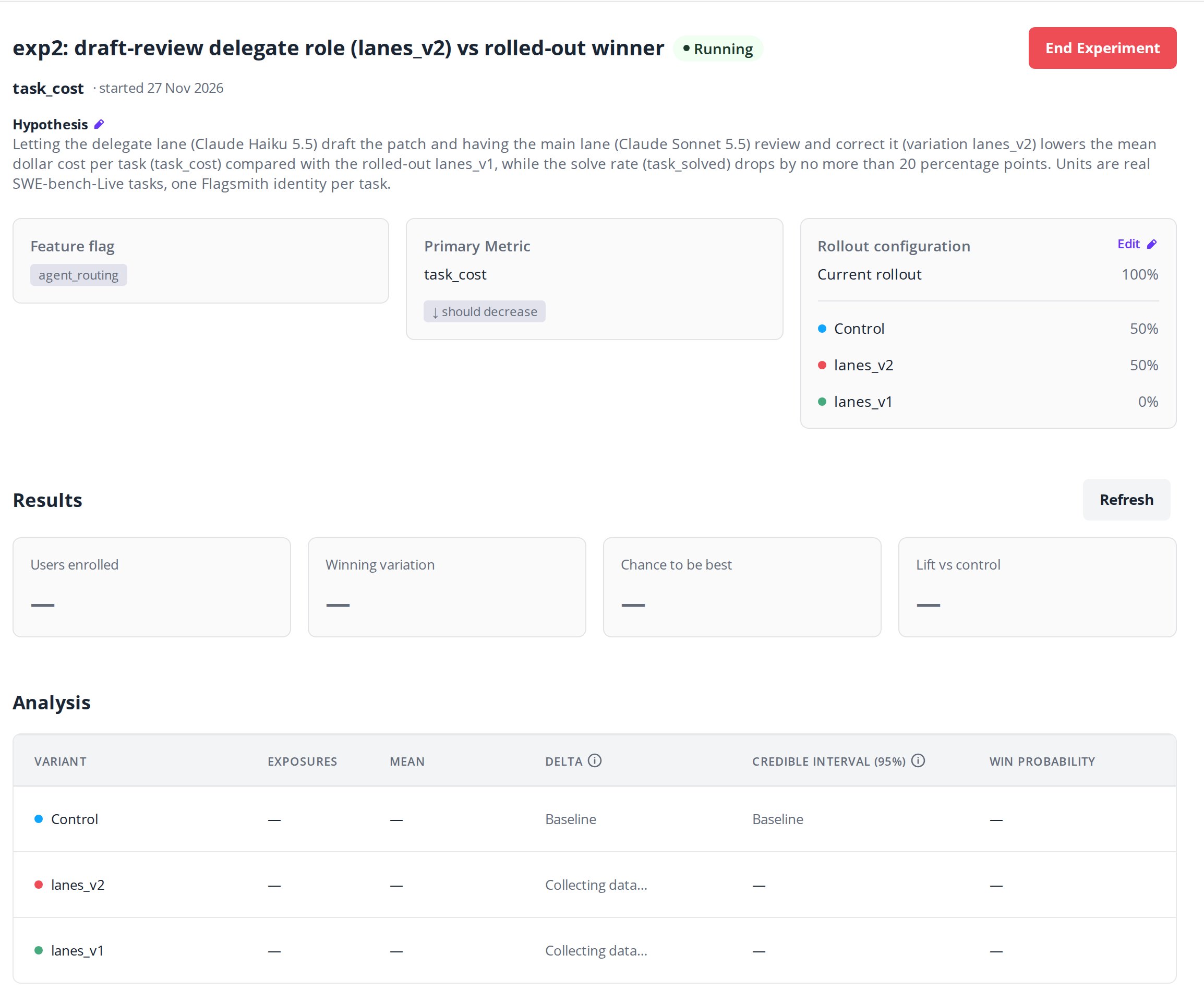
tasks/pools/exp2.jsonl.gz (100 tasks created 2026-03-01 to 2026-06-30) and tasks/pools/exp2b.jsonl.gz (110 tasks: the 58 pre-cutoff tasks left after exp1b in the same seeded order, then 52 tasks created before 2026-03-01 in a separately seeded order). Same stratum as experiment 1 (at most 3 files and 60 changed lines), seed 20261127; tasks/select_tasks.py --exp2b 110 reproduces it and tasks/pools/manifest.json records it. Every task is disjoint from the pilot, experiment 1 and the rollout batch.swelive:<instance_id>. Traits: repo, language, created_month, gold_files, gold_lines.The run
Final The board's own totals for the run, as its API holds them. The analysed figures above come from the ledger, after the registered exclusions.
Connecting to the board…
Open the live boardThe rule, as registered
only if all three hold
task_cost.not mettask_solved as losing (chance to beat control below 5%).metotherwise
Otherwise keep lanes_v1 and publish the reason. A result that keeps lanes_v1 is published in full, with the per-trait tables, the same way a win would be.
The run continues until every task in both pool files is done, excluded or invalid. There is no early stopping on a good or bad result. The flag is not touched while the experiment runs. Only routing_kill may be used, for safety, and any use is logged.
From analysis/power.py seeded with experiment 1's data (145 tasks, solve rate 42.8%), 2000 simulations, seed 20260202, saved as analysis/out/power-exp2/power.json. At 65 tasks per arm:
A smaller cost cut than about a third may go undetected, and only large solve-rate drops can be ruled out. The margin m = 20 points is the same as experiment 1's and was fixed before any experiment 2 task ran.
After this result the flag's own value was set back to the all-frontier control policy and experiment 1 was registered again as experiment 3: the same arms, metrics, margin and rule, on tasks no earlier run has touched. It is decided: lanes_v1 ships again. Registered at , tag prereg-exp3. Experiment 3 on the results page · the registration file